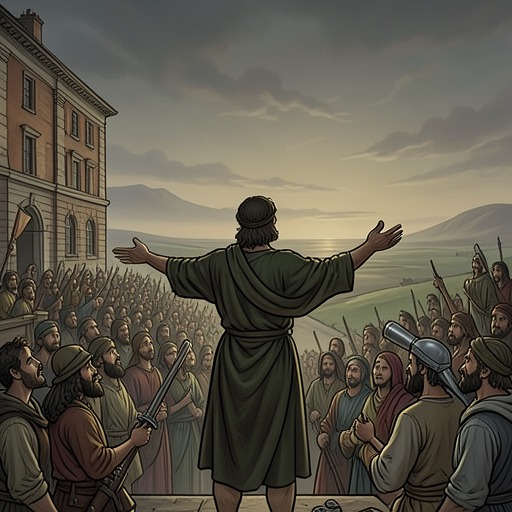
Zarathustra’s Followers
Thus Spoke ZarathustraZarathustra’s Followers are the companions who escort Zarathustra from Pied Cow Town and receive from him a lesson that reverses the usual bond between teacher and pupil. At a crossroads, he gives them Zarathustra’s staff as a farewell gift, then tells them to leave him and become solitary. Their decisive task is not to preserve their attachment to their teacher, but to outgrow it: only after they have lost and denied him, he says, can they return as friends and children of a shared hope.
Departure from Pied Cow Town
When Zarathustra leaves the town to which his heart is attached, many who call themselves his disciples follow and escort him. Their movement together ends at a crossroads. There Zarathustra declares his preference for going alone, making the parting a choice rather than an accident or an expulsion. The followers answer with a gift: Zarathustra’s staff, whose golden handle bears a serpent coiled around a sun. Zarathustra is delighted, leans upon it, and begins to speak about gold’s value.
His account turns the staff into more than a practical object of farewell. Gold, he explains, is rare, useless, shining, and mellow in lustre; its highest value comes from serving as an image of virtue that gives itself. Its gleam becomes the likeness of a giver’s glance, and its lustre makes peace between moon and sun. The gift thus frames the teaching that follows: the followers offer something to their teacher, while Zarathustra makes giving, rather than possession or authority, the measure by which virtue is understood. Their parting gift is a visible token of attachment, but his response redirects attention from the teacher’s importance to the followers’ capacity to become more than receivers.
A farewell that tests discipleship
After speaking about virtue, Zarathustra pauses and balances the staff doubtfully in his hand before resuming in a different voice. The change marks a turn from the image of generous giving to the harder demand of separation. He tells the followers, “I now go away alone, my disciples! You too now go away and be alone! So I will have it.” The repeated command makes solitude reciprocal: Zarathustra will not keep the followers near him, and they are not to make their own solitude dependent on his presence.
He presses the demand further, advising them to go away from him, guard themselves against him, and even be ashamed of him because he may have deceived them. The warning unsettles the security of reverence. A pupil who protects a teacher from challenge risks turning respect into submission; Zarathustra instead says that a person of knowledge must be capable both of loving enemies and hating friends. In this context, hostility toward a beloved teacher can become a form of intellectual independence, not merely a rupture of affection.
Zarathustra also rejects the idea that the best pupil is the one who remains a pupil. He says that a teacher is badly repaid by such continued dependence and asks why the followers should not pluck at his laurels. The image makes the teacher’s prestige something they may actively contest. He warns that their respect could one day collapse like a statue and crush them. Admiration is therefore not harmless if it becomes an immovable monument: the followers must be able to question the figure they honor rather than live beneath it.
Belief, self-discovery, and a future meeting
The sharpest challenge concerns belief itself. Zarathustra asks whether the followers say they believe in him, then asks what importance he has and what importance any believers have. They found him before they had sought themselves, he says, and this order of discovery makes their belief of little account. The criticism is directed not simply at loyalty to one person, but at loyalty that arrives before self-knowledge. If they take Zarathustra’s teaching as a substitute for their own search, they reproduce dependence even while professing conviction.
His instruction is therefore to lose him and find themselves. He sets a condition for his return: only when they have all denied him will he seek his lost ones again. This imagined separation does not cancel affection; it changes its terms. Zarathustra says that he will look for them with different eyes and love them with another love. The followers are to return not as unchanged pupils gathered around a master, but as friends whose judgment and identity no longer depend on believing in him.
He pictures that renewed relation as a bond between friends and “children of one hope.” He says he will be with them a third time so that they can celebrate the great noontide together. The future meeting is thus bound to a transformation in the followers themselves: the group can be re-formed only after the first attachment has been relinquished. Zarathustra describes the great noontide as humanity standing midway between animal and Superman and treating its passage onward as its highest hope. In that image, the followers’ separation belongs to a larger movement of going beyond what one has been; their shared hope is not simply reunion, but the possibility of a new beginning.
The meaning of the followers’ role
The followers’ importance lies in the contradiction Zarathustra insists they hold together. They are attached enough to escort him and give him the staff, yet he warns that attachment can become a danger if it fixes them in the position of believers. His teaching does not ask them to prove their devotion by staying close. It asks them to risk distance, doubt, and even denial as the conditions under which a more independent friendship might become possible.
The crossroads gives this lesson a concrete shape: a company that has traveled together must divide into separate paths. The golden staff remains in Zarathustra’s hand as he announces that division, linking the followers’ gift to his account of virtue while he refuses to make himself the object of permanent dependence. Their farewell is therefore neither a simple dismissal nor a completed reconciliation. It is a proposed interval of self-discovery, with a future reunion imagined but made conditional on the followers first becoming capable of standing apart.